
Most marketing agencies will tell you they understand software. Fewer have shipped anything.
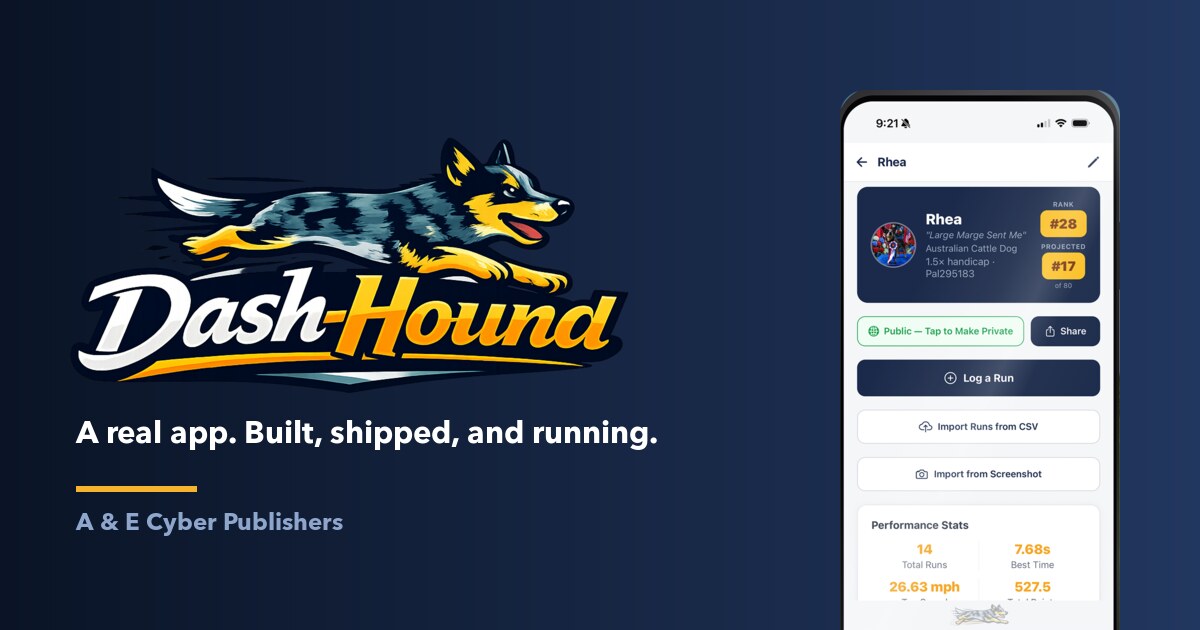
We build custom software for our clients, so a fair question is whether we'd bet our own time on it. We did. It's called Dash-Hound, it's live on iOS and Android, and real people use it every week to track their dogs in a sport most of the world has never heard of.
Here's what building it taught us — and why almost none of the lessons are about code.
What We Built
Fast CAT is an AKC sport where dogs run 100 yards in a straight line, timed, for a top speed in miles per hour. Those times convert to points, and points convert to national rankings by breed.
The community around it was tracking all of this in spreadsheets, screenshots, and memory. Handlers would run their dog on Saturday, then hand-calculate whether that time moved them up the rankings. If they wanted to know which events to enter next, they went hunting across dozens of club websites.
Dash-Hound does that work instead. Log a run, and the app handles the speed, the points, the standings, and a projection of where the season is heading. Events are searchable in one place.
Dog profiles are shareable too, which matters more than it sounds. Co-owners and handlers can see the same dog without anyone texting screenshots around. You can follow a friend's dog and see how their weekend went. And you can follow the dog three places ahead of you in the standings — the one you're quietly trying to run down — and know exactly what you need to beat.
None of that is technically exotic. The value isn't the technology — it's that someone finally pointed the technology at a problem people were solving by hand.
Lesson 1: Build for a Problem You Actually Understand
The reason Dash-Hound works is that we weren't guessing about the problem. We knew what a frustrating Saturday at an event looked like, what handlers argued about, and which numbers people actually cared about.
Most failed custom software fails here, long before anyone writes code. A business commissions an app based on what they assume their team or customers need, and it turns out the real bottleneck was somewhere else entirely.
Before you build anything, you should be able to describe the specific task someone is doing badly right now — with their hands, in a spreadsheet, in a group chat. If you can't name that task, you're not ready to build. You're ready to go watch how people work.
Lesson 2: The Hard Part Is Never the App
The screens were the easy part. The hard part was data.
Getting information in cleanly, keeping it accurate as the source changed, reconciling records that didn't quite match, deciding what to do when two sources disagreed — that's where the real work lived. It's unglamorous, invisible to the user when it goes right, and immediately obvious when it goes wrong.
This is the single most underestimated part of every custom software project we've seen. Clients budget for what they can picture: buttons, screens, a logo in the corner. The cost and the risk live in the plumbing behind them.
When you're evaluating a quote for custom software, ask specifically how data gets in, how it stays correct, and what happens when the source of that data changes. A developer who hasn't thought about it hasn't thought about your project.
Lesson 3: Custom Wins When You Stop Renting
We could have run Dash-Hound on off-the-shelf tools instead. A spreadsheet for the runs, a calendar app for the events, something else again for the standings. Each one close enough to be tempting. None of them actually built for the job — and every one of them billed monthly, forever.
The math on custom software is simple, and most businesses never run it. Add up what you pay every month for tools that only partly fit. Multiply by sixty months. Compare that to building the thing you actually need once and owning it.
Sometimes the subscription still wins. If a tool does exactly what you need and costs less than a nice dinner each month, buy it — we'll tell you that ourselves. But when you're paying for five overlapping tools, exporting between them by hand, and still doing part of the job in a spreadsheet, you're not buying software. You're renting a workaround.
That's the case where custom software pays for itself, and it's more common in small businesses than most owners realize.
Lesson 4: Launch Day Is the Start
Shipping the first version felt like the finish line. It wasn't close.
Real users do things you didn't plan for. Phones update. The data source you depend on changes its format without asking. Someone finds a combination of taps you never imagined and the app does something silly.
Software isn't a project you complete. It's a thing you own and maintain, more like a vehicle than a painting. Any proposal that ends at launch with no answer for what happens in month seven is describing half a job.
Budget for the ongoing work, or the app you paid for slowly becomes an app nobody trusts.
Lesson 5: Narrow Scope Beats Big Budget
The most useful decision we made was cutting things.
Dash-Hound could have launched with training logs, a social feed, video analysis, breeding records, and a marketplace. It would still be in development today, and it would be worse.
Instead it does a small number of things thoroughly. That's not a compromise — it's the reason it's finished and useful. Every feature you add is another thing to design, test, explain, fix, and maintain forever.
If your budget feels too small for the app you're imagining, the usual answer isn't a bigger budget. It's a smaller first version that actually ships, earns its keep, and tells you what to build next based on evidence instead of guesses.
What This Means for Your Business
You probably don't need a dog-sport app. But the pattern behind it shows up everywhere:
- Someone on your team spends hours every week moving data between systems by hand
- You pay for several tools that each do part of a job, and none do all of it
- The thing that makes your business genuinely different is the thing no off-the-shelf software supports
- You've been told "just use a spreadsheet" for something that clearly outgrew a spreadsheet
Any one of those is worth a conversation. Not necessarily an app — sometimes the answer is a better website, a smarter integration, or automating one specific step rather than building a whole platform.
We build these for clients the same way we built our own: figure out the real problem first, cut the scope hard, get something working, then improve it with what we learn.
If you're weighing whether custom software makes sense for your business, let's talk it through. We start with a Zoom call to understand what you're actually dealing with — and if you're local to Bethlehem or the Lehigh Valley, we're happy to do it in person.
You can see Dash-Hound for yourself at dashhound.app.