
Every time a business pastes a customer record into a chat window, that data leaves the building. Usually that's fine. Sometimes it very much isn't.
If you handle medical information, legal files, financial records, or anything covered by a contract that says where data may live, there's a version of AI that never sends anything anywhere: you run the model on your own hardware.
It's more achievable than most business owners assume, and it isn't right for everyone. Here's the honest picture.
What Self-Hosted Actually Means
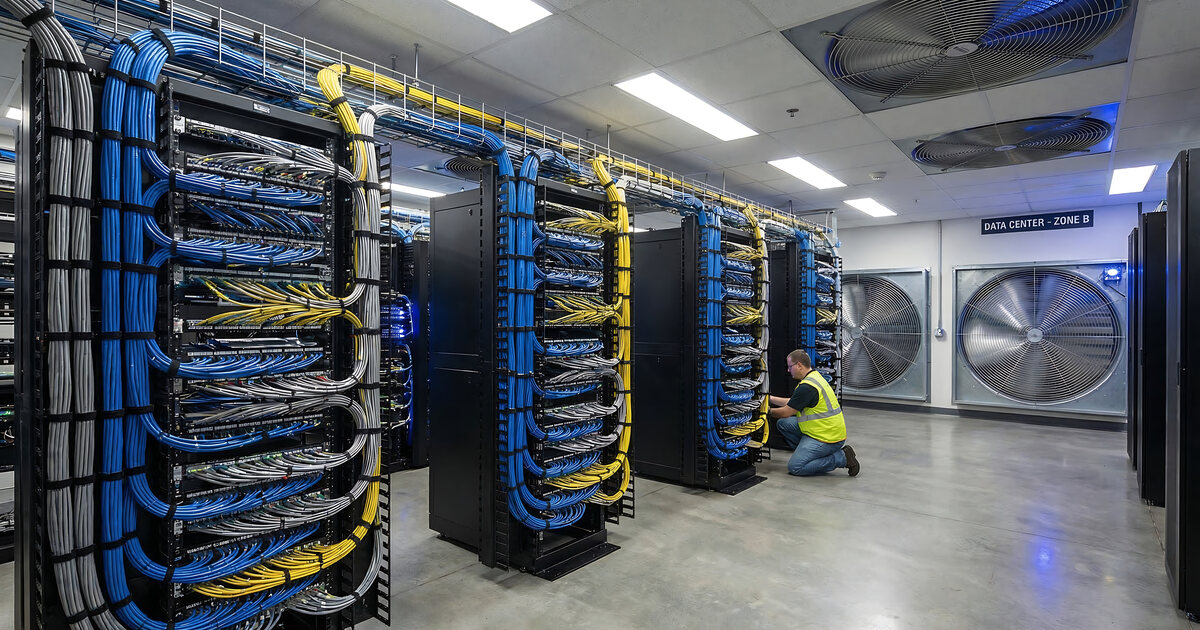
Instead of your text going to a company's servers, a model runs on a machine you own — in your office, or on a server you rent and control. Questions go in, answers come out, and nothing crosses the internet.
The tooling for this has become genuinely good. Open-weight models you can download and run have closed much of the gap with the big commercial services, and the software to run them is now approachable rather than a research project.
The Honest Trade-Offs
What you gain:
- Data never leaves your control. For some businesses this converts "we can't use AI" into "we can."
- No per-seat pricing. Once it's running, twenty people cost the same as two.
- It keeps working. No vendor deprecating the model you built around.
- Compliance conversations get much shorter.
What you give up:
- The very best models are still the hosted ones. A self-hosted model is capable, not state-of-the-art.
- You own the machine. It needs maintaining, updating, backing up.
- Hardware costs money up front instead of monthly.
- Someone has to care about it. If nobody does, it rots.
When It's Worth It
Self-hosting makes sense when at least one of these is true:
- Regulation or contract forbids sending data out. The clearest case by far.
- Your clients ask where their data goes. Being able to answer "it doesn't leave our building" wins work in some industries.
- You have lots of users doing routine work. Per-seat costs stop scaling and a one-time hardware spend starts looking sensible.
- The work is high-volume and unglamorous. Summarising, extracting, classifying, drafting from templates. A mid-sized local model is entirely adequate for this.
When It Isn't
Don't self-host if:
- You need frontier-level reasoning on hard problems. Pay for the hosted model; it's better.
- You have five people and no one who enjoys servers.
- Your data isn't sensitive and you just like the idea of owning it. That's a hobby, and an expensive one.
- You haven't yet proven the use case. Prove it on a hosted service first, then move it in-house if the numbers justify it.
That last point is the practical order for almost everyone: start hosted, confirm it's genuinely useful, then decide whether it needs to come home.
What It Takes
Less than you'd think. A single well-specified machine with a capable graphics card handles a small team comfortably. The software layer — a model runner plus a web interface your staff use in a browser — is mature and free.
The real cost isn't the hardware. It's having someone responsible for it. That can be an internal person who's interested, or it can be us. It cannot be nobody.
The Middle Path
Most businesses that care about this land somewhere in between rather than at one extreme: sensitive work stays on the local model, general work goes to the hosted service, and there's a written rule telling staff which is which.
That's usually the right answer. It gets you compliance where you need it and capability where you don't, without pretending you have to pick a side.
We set this up for businesses across Bethlehem, Allentown, Easton and the Lehigh Valley — including the awkward part, which is deciding what genuinely needs to stay in-house versus what merely feels like it should. That conversation saves more money than the hardware choice does.
If "we'd like to use AI but our data can't leave" describes you, let's talk. There's very likely a version of this that works for your situation.